
Tesla Wall Connector Installation in Leander, TX
The Tesla Wall Connector is the fastest, most convenient way to charge a Tesla at home — hardwired to a dedicated 60-amp circuit, it can add up to about 44 miles of range per hour. Leander EV Charger Pros is a free referral service: when you call, we connect you with independent local professionals in Leander who can install a Wall Connector safely and to code. There is no charge for the referral and no obligation.
Free referral service — we connect you with independent local installation professionals. We do not perform installations ourselves.
What a Tesla Wall Connector Install Involves
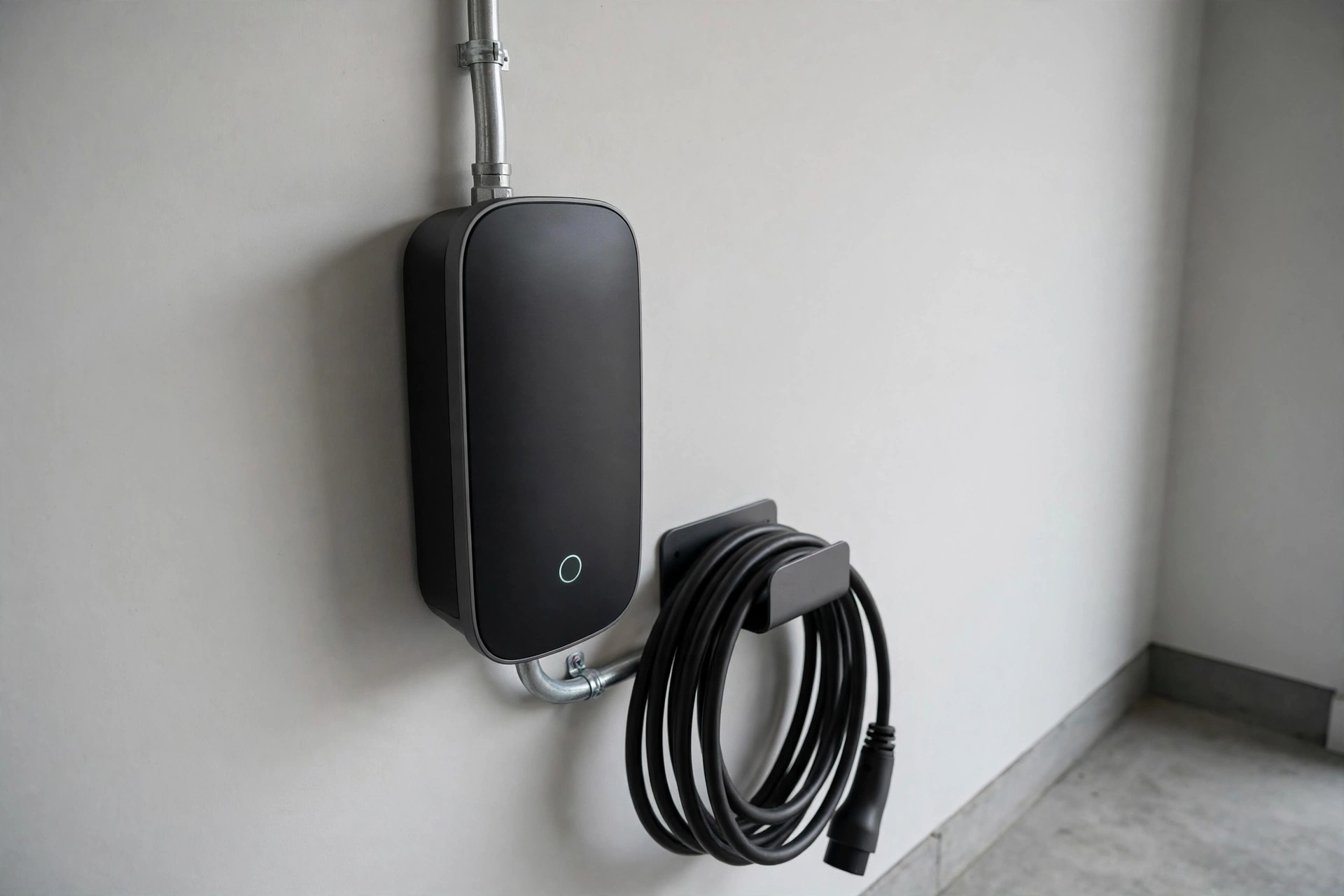
Unlike a portable Mobile Connector that plugs into an outlet, the Tesla Wall Connector is a permanent, hardwired charging station mounted on your garage or exterior wall. Because it is hardwired rather than plugged in, it can run at up to 48 amps on a 60-amp circuit — roughly 50% faster than the typical plug-in setup through a NEMA 14-50 outlet.
A professional installation typically includes a load calculation on your electrical panel, running the new dedicated circuit from the panel to the mounting location, installing the correct breaker, mounting and wiring the unit, and testing it with your vehicle. Many installations also involve a permit and inspection, which local professionals generally handle as part of the job.
If you are comparing your options, our Level 2 charger installation page explains how hardwired stations like the Wall Connector compare with other home charging setups. And if your panel is already full, an electrical panel upgrade may be needed first — something the provider can assess during the quote.
Why Leander Tesla Owners Choose a Wall Connector
- Faster overnight charging: up to about 44 miles of range per hour at 48 amps means most Teslas recharge fully while you sleep.
- Works with any Tesla: Model 3, Model Y, Model S, Model X, and Cybertruck all charge through the same connector.
- Charges non-Tesla EVs too: with a J1772 adapter or the Universal Wall Connector version, households with a second non-Tesla EV are covered.
- Power sharing: up to six Wall Connectors can share one circuit — useful if your household runs two or more Teslas.
- Weather-sealed design: rated for indoor and outdoor installation, so driveway or carport mounting is an option.
- Always ready: no cable to unpack and repack — you arrive home, plug in, and walk away.
Leander sits in one of the top EV-density areas in Texas, and Teslas are a common sight in neighborhoods across 78641 and 78645. For many owners here, EV charger installation in Leander starts with the Wall Connector because it is the fastest home option Tesla makes — and because a hardwired install adds a clean, permanent charging setup to the garage.
Standard or Universal Wall Connector: Which Should You Buy?
Tesla sells two versions of the Wall Connector, and the choice matters more than most buyers realize. The standard Wall Connector comes with Tesla's own connector (the NACS plug). It charges every Tesla — and, because most major automakers have adopted the same NACS standard on their newer models, a growing number of new non-Tesla EVs as well.
The Universal Wall Connector carries the same Tesla plug plus a J1772 adapter docked neatly in the unit itself. That adapter is what most earlier non-Tesla EVs — and many plug-in hybrids — use to charge. If your household pairs a Tesla with a Ford, Hyundai, Rivian, or a plug-in hybrid, the Universal version charges both from one unit, with the adapter stored in the connector instead of loose in a drawer.
Our honest guidance: if every vehicle you own, or realistically plan to own next, is a Tesla or a newer NACS-equipped EV, the standard version is all you need. If a J1772 vehicle shares your garage now — or might in the next few years — the Universal version is the future-proof choice, and it keeps the garage ready for a mixed EV fleet. Your installer can confirm which plug each of your vehicles uses before you order.
How the Installation Process Works
- Call for your free referral. Tell us you drive a Tesla and want a Wall Connector installed. We connect you with an independent local professional — free, no obligation.
- On-site assessment and quote. The provider checks your panel's capacity, the distance to your preferred mounting spot, and whether a permit is needed, then gives you a quote for the work.
- Permitted, code-compliant install. The electrician runs the dedicated circuit, mounts and wires the Wall Connector, and arranges any required inspection.
- Test and hand-off. The unit is powered up, tested with your Tesla, and connected to the Tesla app so you can schedule charging and monitor sessions.
Because we are a referral service rather than a contractor, the Leander EV charger installers we connect you with are independent businesses. Ask any provider you speak with about their licensing, insurance, and experience with Tesla Wall Connectors before work begins.
Sizing the Circuit to Your Panel
Full speed — 48 amps on a 60-amp circuit — is what most buyers picture, but the Wall Connector does not demand it. The unit is configured during setup for the circuit it is actually on: a 50-amp circuit delivers 40 amps of charging, a 40-amp circuit delivers 32 amps, and even a 30-amp circuit delivers 24 amps — still several times faster than a household outlet, and enough to refill a typical day's driving overnight. A good installer sizes the circuit to what your panel can honestly support instead of forcing the maximum.
For panels that cannot pass even a modest circuit, Tesla supports pairing the Wall Connector with a compatible home energy meter that watches the whole house's draw and adjusts charging to stay within the panel's limit — full speed when the house is quiet, a gentler rate when everything is running at once. That is the load-management approach in our guide to charging without a panel upgrade, and it is often the difference between installing this week and taking on a much larger electrical project first. When the panel itself is old or unsafe, of course, the honest answer is still an electrical panel upgrade — the load calculation, not the brochure, makes that call.
Charging at Home in Leander
Leander's rapid growth — nearly 48% population growth between 2020 and 2024 — means many homes here are newer construction with 200-amp service and room in the panel for a 60-amp EV circuit. In those homes, a Wall Connector install is often straightforward: a short conduit run from the panel to the garage wall and you are charging the same day. Older homes or homes with full panels may need a panel upgrade first, which the provider can quote alongside the Wall Connector work.
One honest note on costs: the federal Section 30C residential charger credit expired after June 30, 2026, so it should not be factored into your budget. We are also not aware of a verified utility rebate in Leander — our guide to the Austin Energy rebate question explains why Leander, on Oncor wires, sits outside that program. What remains real is the day-to-day value — home charging typically costs far less per mile than public fast charging or gasoline, and waking up to a full battery never gets old.
Two Teslas, One Circuit: Power Sharing in Practice
Leander has plenty of two-Tesla garages, and the instinct is to assume each car needs its own 60-amp circuit. Usually it does not. Tesla's Power Sharing links multiple Wall Connectors — up to six — on a single circuit and lets them divide the available power intelligently. Plug in both cars in the evening and they share the circuit; when one reaches its charge limit, the other automatically takes the full rate. By morning, both are ready.
Beyond saving panel capacity, sharing one circuit means one wire run instead of two — a materially simpler install in a finished garage, whether the connectors sit side by side in a Travisso or Crystal Falls two-car garage or serve one car inside and a Cybertruck on the driveway. The units coordinate with each other, which the installer configures during commissioning, and each car still charges on its own schedule in the Tesla app. For households planning a second EV within a year or two, it is worth mentioning on the first install: the circuit and mounting can be planned so the second connector becomes a short addition later, not a second project.
What Affects the Cost of a Wall Connector Install
We do not quote prices — every home is different, and the independent provider who assesses your home will give you the actual number. The factors that move a quote up or down include:
- Distance from panel to charger: a garage wall next to the panel is the simplest run; a detached garage or long conduit path adds labor and materials.
- Panel capacity: if your panel has space and spare amperage, the install is simple. If not, a panel upgrade or load-management device enters the picture.
- Wall and attic routing: finished walls, long attic runs, or trenching to a detached structure add time.
- Permits and inspection: local permit fees and the inspection visit are usually part of the job.
- The Wall Connector unit itself: purchased separately — confirm with the provider whether you should buy it or they will supply it.
When you call (512) 564-8225, we will connect you with a local professional who can look at your specific setup and give you a straight answer on cost.
Frequently Asked Questions
What is a Tesla Wall Connector?
The Tesla Wall Connector is Tesla's hardwired home charging station. Mounted on your wall and wired to a dedicated circuit (typically 60 amps), it delivers up to 48 amps of charging power — the fastest home charging option Tesla offers, adding up to about 44 miles of range per hour depending on the model.
Can a Tesla Wall Connector charge a non-Tesla EV?
Yes. With a J1772 adapter — or by choosing Tesla's Universal Wall Connector, which has the adapter built in — a Wall Connector can charge most non-Tesla electric vehicles. If your household has mixed EVs, mention it when you call so the provider can recommend the right version.
Does a Wall Connector need a dedicated circuit?
Yes. It is hardwired to its own dedicated circuit, commonly 60 amps for full 48-amp output. The installing electrician will run a load calculation to confirm your panel can support it and will pull any required permits.
Should I get a Wall Connector or just a NEMA 14-50 outlet?
A Wall Connector charges faster (up to 48 amps versus about 32 amps through a 14-50 with a Mobile Connector), is weather-sealed for outdoor mounting, and supports power sharing between multiple units. A NEMA 14-50 outlet is more flexible and usually cheaper to install, and it can also power an RV. Many Tesla owners who charge daily choose the Wall Connector; an independent local provider can compare both for your situation.
Will I need an electrical panel upgrade too?
Possibly. A 60-amp EV circuit needs real spare capacity in your panel. Newer Leander homes with 200-amp service often have room; older or heavily loaded panels may not. The provider assesses this during the quote — see our panel upgrade page for what that involves.
Is the federal EV charger tax credit still available?
No. The federal Section 30C residential charger credit expired after June 30, 2026. We are not aware of a verified Leander utility rebate either. Ask a tax professional about any current programs that might apply to your situation.
Do I need a permit to install a Tesla Wall Connector in Leander?
Yes. A new 240-volt circuit requires an electrical permit from the City of Leander and a follow-up inspection once the work is done. The installing electrician pulls the permit as part of the job — it is one of the first things to confirm when you are connected with a provider. Our guide to EV charger permits in Leander walks through the full process.
How long does a Tesla Wall Connector installation take?
For a standard installation — a panel with spare capacity and the charger mounted in the garage — the physical work is usually finished in a single visit of a few hours. Longer wire runs, an outdoor mount, or a panel that needs work first can extend the job. The provider can give you a realistic timeline after seeing your garage and panel.
Can I install two Wall Connectors for two Teslas?
Yes. Tesla's Power Sharing feature lets multiple Wall Connectors — up to six on a single circuit — communicate and divide the available power between vehicles, so two Teslas can charge overnight without a second full-size circuit. It is a popular setup for two-EV households in Leander's newer subdivisions.
Does a Tesla Wall Connector need Wi-Fi to work?
Wi-Fi is needed for setup, firmware updates, and configuring features like Power Sharing, but once the unit is configured it charges your vehicle whether or not the connection is up. If your garage has a weak Wi-Fi signal, tell the installer — placing an access point nearby solves most cases.
Get Your Tesla Wall Connector Installed in Leander
Call now and we will connect you — free — with an independent local professional who installs Tesla Wall Connectors in Leander, TX. No obligation, no pressure.
Call Now to Get Connected