
Commercial EV Charging Stations in Leander, TX
Workplaces, retail centers, restaurants, apartment communities, and fleets across Leander are adding EV charging — to attract customers, retain employees, serve residents, and prepare for what's coming. Commercial projects are a different animal from a home garage install: load studies, multi-station design, trenching, billing systems, and utility coordination. Leander EV Charger Pros is a free referral service: call us and we will connect your business with independent local professionals experienced in commercial EV charging projects.
Free referral service — we connect you with independent local installation professionals. We do not perform installations ourselves.
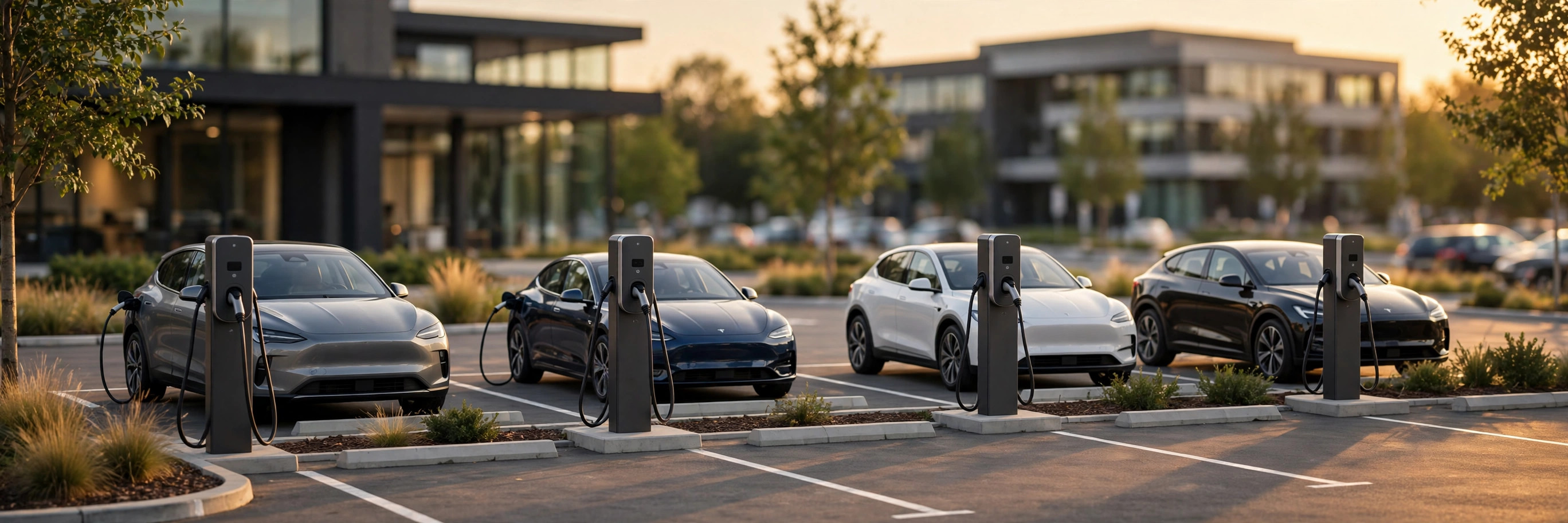
What Commercial EV Charging Involves
A commercial charging project starts with questions a home install never asks: how many stations, for whom, and for how long will each car park? A workplace where employees park for eight hours needs a different design than a restaurant where diners stay ninety minutes. Providers typically begin with a site walk and a load study of the building's electrical service, then design the station count, layout, and power distribution around real usage.
The hardware differs too. Commercial sites usually run networked Level 2 stations — the same 240-volt technology as home charging, built for public use with payment processing, access control, and usage reporting. Sites needing fast turnover may add DC fast chargers, which charge in minutes but demand far more power and a much larger investment. Load management software ties it together, letting a dozen stations share electrical capacity that could never feed them all at full power simultaneously.
Then comes the civil work: trenching across parking lots, concrete pads and bollards, signage and striping, lighting, and ADA-accessible layouts. It is a construction project with an electrical core — which is why the provider's commercial experience matters more than anything else. Ongoing maintenance and repair keeps the stations earning their keep after install day.
Who Adds EV Charging — and Why
Workplaces
Employee charging is a retention and recruitment tool, especially with Leander's commuter workforce heading to Austin daily. Level 2 stations in the employee lot let staff arrive home with range to spare — a benefit that costs the employer relatively little per session.
Retail & Restaurants
EV drivers choose where to stop partly by where they can charge. Stations in your lot turn a 45-minute dwell into a sale, and charging-network maps put your business in front of drivers who have never heard of you.
Apartments & HOAs
Residents without garages cannot install their own chargers — shared or assigned-space stations solve it. Load management lets many stations share limited building capacity, and billing systems allocate costs fairly.
Fleets
Delivery vans, service trucks, and municipal vehicles with predictable routes are ideal for electrification. Depot charging is usually overnight Level 2, scheduled when electricity is cheapest, with telematics to prove the savings.
Leander's growth story is the business case in one line: roughly 87,500 residents, nearly 48% growth since 2020, top-tier EV adoption for Texas, and household incomes around $139,000. The EV drivers are already your customers, employees, and residents — our Leander referral service for EV charging connects businesses with local professionals who can put stations in front of them.
How a Commercial Project Works
- Call for your free referral. Tell us about your property and goals — station count, user type, timeline. We connect you with an independent local professional experienced in commercial work — free, no obligation.
- Site assessment and load study. The provider walks the site, studies the building's electrical service, and designs station placement, power distribution, and any needed service upgrades.
- Proposal and permitting. You receive a designed proposal covering hardware, civil work, networking, and billing setup. Permits are pulled and the utility coordinates any service-side work.
- Build, commission, and hand off. Trenching, electrical, mounting, networking, and testing — then the stations go live with billing, access control, and reporting configured, plus a maintenance plan.
Expect a longer timeline than residential work — weeks for a simple two-station workplace install, months for larger sites with service upgrades. The providers we refer will give you a realistic schedule during the proposal phase, not after you have committed. And if anyone on your team also needs home EV charger installation in Leander, that is the residential side of the same referral service.
Leander's Commercial Landscape
Leander is not just growing residentially — new retail corridors, medical offices, and mixed-use development are filling in along the 183A corridor and in master-planned communities. For these properties, EV charging is increasingly a checkbox item: tenants ask about it, employees expect it, and in competitive leasing it differentiates a building the way covered parking once did.
Apartment communities deserve special attention here. A large share of Leander's growth has come through multifamily and build-to-rent development, and those residents are exactly the EV owners who cannot install a home charger. Properties that solve this with well-designed shared charging — fairly billed, reliably maintained — turn a pain point into an amenity. Properties that ignore it will hear about it at every lease renewal.
What Affects Commercial Project Cost
Commercial pricing is project-specific — we do not quote it, and any provider worth hiring will want to see your site first. The factors that drive the number:
- Station count and type: networked Level 2 stations are the economical workhorse; each DC fast charger multiplies hardware and electrical costs substantially.
- Distance from electrical service: stations far from the building's service entrance mean long trenching runs — often the single biggest civil cost.
- Service capacity: if the building's service cannot carry the new load, upgrades or a new service enter the budget; load management can reduce this.
- Civil work: trenching, concrete cutting and restoration, bollards, signage, striping, and lighting.
- Networking and billing: cellular or Wi-Fi connectivity, payment processing setup, and software subscriptions for access control and reporting.
- Permits and utility work: commercial permits, inspections, and any utility-side upgrades, coordinated on a longer timeline than residential.
Call (512) 564-8225 and describe your property — we will connect you with a local professional who can walk the site and build you a real proposal.
Frequently Asked Questions
What types of businesses install EV charging stations?
The most common: workplaces offering employee charging, retail and restaurant locations attracting EV-driving customers, hotels, apartment communities and HOAs serving residents, and fleets electrifying work vehicles. Each use case points to different hardware, station counts, and billing setups.
Should a business choose Level 2 or DC fast charging?
It depends on dwell time. Workplaces, apartments, and hotels — where cars park for hours — are well served by Level 2 stations at far lower cost. Sites needing quick turnover, like highway-adjacent retail, may justify DC fast chargers, which are substantially more expensive to purchase, install, and power. Most Leander businesses start with Level 2.
Will our building need an electrical upgrade for EV chargers?
Often, yes — multiple charging stations add up to a large new load. Providers start with a load study of the building's service, then design around it: panel or service upgrades for larger projects, or load management software that lets more stations share existing capacity.
Can we charge drivers for using our stations?
Yes. Networked commercial stations support payment processing, per-kWh or per-session billing, access control, and usage reporting. Some businesses price at cost, some price for profit, and some offer free charging as an amenity — the provider can walk through the trade-offs.
How do EV chargers work for apartments and HOAs?
Multifamily sites typically use either assigned-space chargers billed to individual units or shared stations with access control and billing. Load management is especially valuable here, distributing limited building capacity intelligently across many stations so the electrical service does not need a massive upgrade.
How long does a commercial charging project take?
Longer than a residential install. Commercial projects involve site design, load studies, permits, trenching and concrete work, utility coordination, and sometimes service upgrades. Expect weeks for a simple two-station workplace install and months for larger sites.
Bring EV Charging to Your Leander Business
Call now for a free referral to an independent local professional experienced in commercial EV charging projects in Leander, TX — site assessment, honest proposal, no obligation.
Call Now for Your Free Quote