
Level 2 EV Charger Installation in Leander, TX
A Level 2 charger is the standard home EV setup: a 240-volt dedicated circuit that charges roughly five to seven times faster than a regular wall outlet — typically about 20 to 30 miles of range per hour, enough to fully recharge most EVs overnight. Leander EV Charger Pros is a free referral service. Call us and we will connect you with independent local professionals in Leander who install Level 2 home chargers safely and to code.
Free referral service — we connect you with independent local installation professionals. We do not perform installations ourselves.
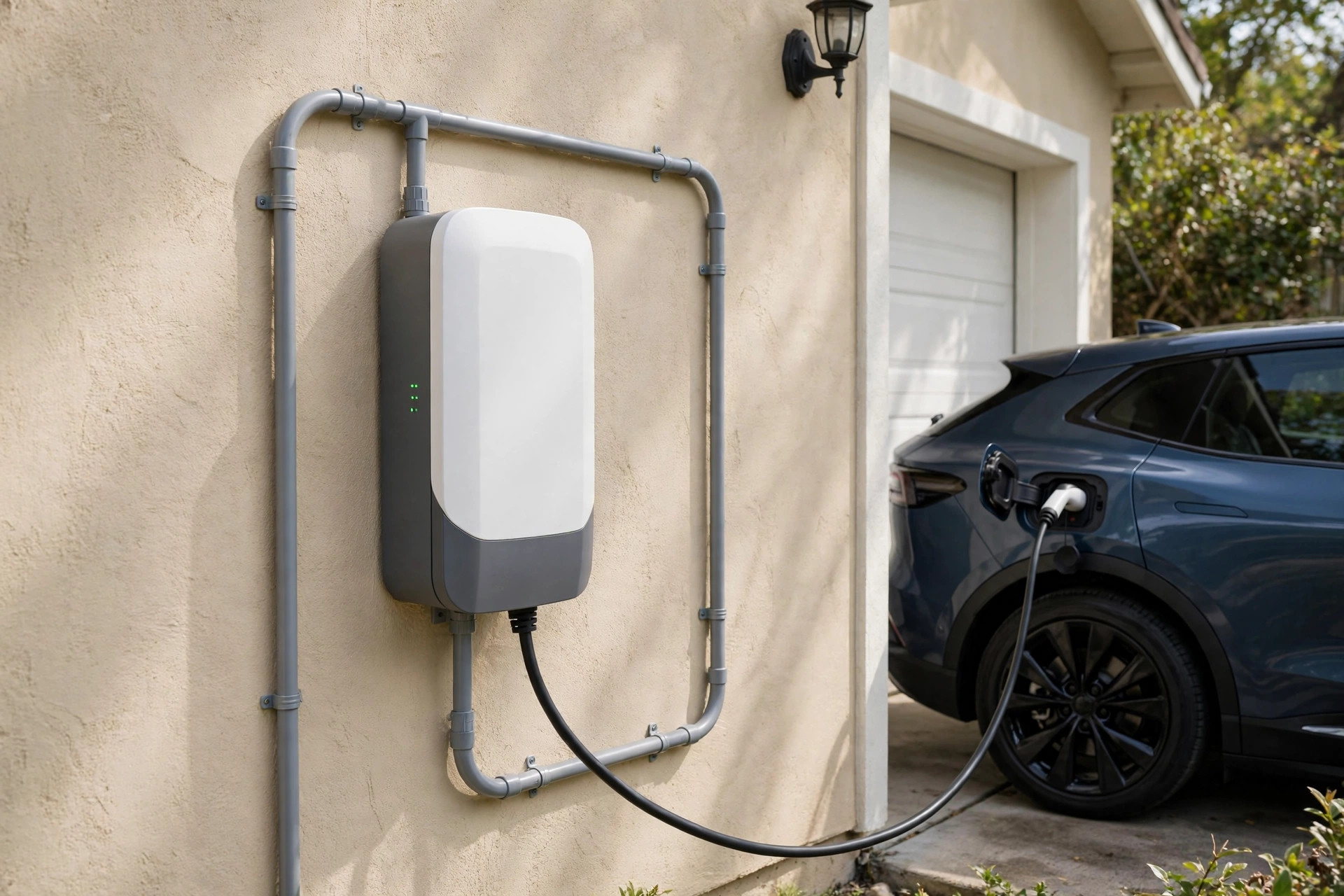
What Level 2 Installation Involves
Every EV ships with a Level 1 cord that plugs into a standard 120-volt outlet — but at 3 to 5 miles of range per hour, it can take two days to recharge a depleted battery. Level 2 moves to 240 volts on a dedicated circuit, usually 40 to 60 amps. That is the setup the vast majority of EV owners in Leander end up with, because it turns an overnight park in the garage into a full battery every morning.
A professional install starts with a load calculation to confirm your panel can carry the new circuit. The electrician then runs wiring from the panel to the charger location, installs the correct breaker, mounts the unit (hardwired) or installs the receptacle (plug-in), and tests the full charge cycle. Permits and inspection are normally part of the job.
Two common configurations exist: a hardwired station (like the Tesla Wall Connector) or a plug-in charger connected to a NEMA 14-50 outlet. If your panel lacks capacity, an electrical panel upgrade may be needed first — the provider can assess that during the quote.
Key Decisions Before You Install
Hardwired vs. Plug-In
Hardwired stations support the highest amperage (up to 48–60 amps) and are required above 50 amps. Plug-in chargers on a 14-50 outlet are portable and simpler to replace, but top out around 40 amps of charging. A local pro can recommend the right fit for your vehicle and panel.
Amperage and Circuit Size
Most homes land on a 40-, 50-, or 60-amp circuit. Higher amperage means faster charging but demands more panel capacity. The right size depends on your EV's onboard charger and your daily driving — not every car benefits from the maximum.
Charger Brand
Providers may install units from makers such as ChargePoint (Home Flex), Grizzl-E, Emporia, or Tesla, among others — named here only as examples of what is commonly available, not as endorsements. What matters most is correct sizing, a clean install, and a unit rated for your indoor or outdoor location.
Smart Features
Many Level 2 chargers connect to Wi-Fi for scheduled charging, energy monitoring, and app control. Scheduling your charge for off-peak overnight hours is the simplest way to keep electricity costs down.
For most Leander households, home EV charging in Leander comes down to one question: how many miles do you need back each night? If your commute is 40–60 miles round trip, even a 40-amp Level 2 setup gives you a comfortable margin — and our Leander EV charger referral service can connect you with someone who will size it honestly rather than upsell you.
How the Installation Process Works
- Call for your free referral. Tell us about your EV and your home. We connect you with an independent local professional — free, with no obligation.
- Assessment and load calculation. The provider checks your panel capacity, breaker space, and the best charger location, then recommends hardwired or plug-in and quotes the work.
- Permitted installation. The electrician runs the 240-volt circuit, mounts the charger or receptacle, pulls the permit, and arranges inspection.
- Testing and setup. The charger is powered up, tested with your vehicle, and connected to its app so you can schedule charging and track energy use.
Level 2 Charging Fits Leander's Growth
Leander is one of the fastest-growing cities in Texas — roughly 87,500 residents as of 2024, up nearly 48% since 2020 — with a median household income around $139,000 and EV adoption that ranks among the highest in the state. That combination means a lot of new garages, a lot of new EVs, and a lot of homeowners discovering that a standard outlet cannot keep up with a 60-mile daily commute to Austin.
Most of Leander's newer subdivisions were built with 200-amp service, which usually has room for a 40- or 50-amp EV circuit without major electrical work. Older pockets of the city and homes with already-loaded panels are the ones where a provider is most likely to recommend a panel upgrade or a load-management device. Either way, the assessment is the step that matters — and it is exactly what the independent professionals we refer you to perform before quoting.
What Affects the Cost of a Level 2 Install
We never quote prices ourselves — the independent provider who sees your home gives you the real number. These are the factors that shape it:
- Panel-to-charger distance: the shorter the wire run, the simpler the job. A charger on the garage wall beside the panel is the best case.
- Panel capacity: spare breaker space and spare amperage keep things simple; a full or undersized panel adds upgrade work.
- Hardwired vs. receptacle: hardwired stations involve more wiring labor; a 14-50 receptacle install is generally simpler.
- Routing challenges: finished drywall, long attic runs, or trenching to a detached garage add time and materials.
- Permit and inspection fees: typically included in the provider's quote.
- The charger unit: confirm whether the provider supplies it or you purchase it separately.
One thing to leave out of your math: the federal Section 30C residential charger credit expired after June 30, 2026, and we are not aware of a verified Leander utility rebate. Budget for the install itself — and ask your provider about scheduling charging during off-peak hours to keep running costs low.
Frequently Asked Questions
What is the difference between Level 1 and Level 2 charging?
Level 1 uses a standard 120-volt household outlet and adds roughly 3–5 miles of range per hour — adequate for plug-in hybrids, painfully slow for full EVs. Level 2 uses a 240-volt dedicated circuit and typically adds about 20–30 miles of range per hour, so most EVs recharge fully overnight. That speed gap is why nearly all EV owners who charge at home choose Level 2. We walk through the numbers in our guide to Level 1 vs Level 2 charging.
How long does a Level 2 charger installation take?
Most straightforward installations are completed in a few hours by the provider's electrician — mount the unit, run the circuit, test, done. Jobs that need a panel upgrade, long conduit runs, or trenching to a detached garage take longer, and the provider will tell you upfront.
Will I need an electrical panel upgrade for a Level 2 charger?
It depends on your panel's spare capacity. A Level 2 charger needs a 240-volt dedicated circuit, commonly 40–60 amps. The electrician runs a load calculation before quoting; if your panel is full or your service is undersized, an electrical panel upgrade may be recommended. Many newer Leander homes with 200-amp service have room without one.
Hardwired charger or NEMA 14-50 outlet — which should I choose?
Hardwired stations support the highest amperage (up to 48–60 amps) and are required for circuits above 50 amps. A NEMA 14-50 outlet with a plug-in charger is more flexible — you can take the charger with you if you move — but tops out around 40 amps of charging. The provider can recommend the right option for your vehicle and panel.
Can a Level 2 charger be installed outdoors?
Yes. Many home chargers are rated for outdoor use, so driveway or carport mounting is common. Outdoor installs need weatherproof wiring methods and proper code compliance, which the installing electrician handles.
Do I need a permit to install a Level 2 charger in Leander?
Electrical permits are generally required for new 240-volt circuits. Local installation professionals typically handle the permit application and the inspection as part of the job, so you do not have to deal with the city yourself.
How many miles of range does a Level 2 charger add per hour?
Typically 25 to 45 miles of range per hour of charging, depending on the charger's amperage and how much power your vehicle can accept. A 40-amp circuit covers most daily driving in a few hours, while a 60-amp setup suits long commutes and larger batteries. Either way, waking up to a full battery is the norm.
Will a Level 2 charger work with any electric vehicle?
Almost all of them. Level 2 chargers sold in North America use the standard J1772 connector — or NACS on newer units — and Tesla vehicles charge from J1772 stations with the adapter included with the car. When you call, tell us what you drive and the provider will match the right connector and amperage.
Can one Level 2 charger serve two EVs?
Yes, a few ways: dual-port chargers serve two cars from one unit, smart chargers can power-share a single circuit between two vehicles, and many households simply alternate nights. For two EVs driven hard every day, the provider may recommend a power-sharing setup or two circuits after a load calculation.
Can a Level 2 charger be installed in a detached garage?
Yes. The electrician runs a feeder from your main panel to the garage — sometimes adding a small subpanel there — either overhead or trenched underground. Detached garages and workshops are common on the larger lots around Leander and Liberty Hill, and local providers handle this layout regularly.
Is the federal tax credit for home chargers still available?
No. The federal Section 30C residential charger credit expired after June 30, 2026. We are not aware of a verified Leander utility rebate. A tax professional can advise on any current programs.
What size (amperage) Level 2 charger do I need?
It depends on your vehicle and your daily driving. A 40-amp charger covers most households comfortably. A 32-amp unit suits smaller batteries and shorter commutes, while a 48-amp hardwired charger suits long commutes and larger batteries that need a faster overnight turnaround. The other limit is what your vehicle can accept — there is no benefit in a charger stronger than your car's onboard limit — and what your panel can spare. The provider matches all three before recommending a size.
What if my panel is full but I do not want a full upgrade?
A full upgrade is not always the only answer. If the load calculation shows the panel is tight rather than unsafe, the provider may suggest a load management system that pauses EV charging when the rest of the house peaks, a lower-amperage charger, or a small subpanel for the charger circuit. We explain how load management works in our guide to EV charger load management. Note that certain older panel brands are a safety concern on their own and usually need replacing regardless — the electrician will flag that if it applies to your home.
What happens during the inspection, and can I use the charger before it passes?
The city inspector checks the circuit, breaker size, wiring method, and labeling, and confirms the work matches the permit. Your provider schedules the inspection and corrects anything flagged, then arranges a re-inspection. Use the charger after the job passes — not before. For homes inside Leander city limits the permit goes through the City of Leander (Leander spans Williamson and Travis counties, but the permit itself is city-level), and local providers handle the paperwork as part of the job.
Can I install a Level 2 charger in a rental home or an HOA neighborhood?
Renters need the landlord's written permission first, since this is a fixed electrical installation. In HOA neighborhoods — common across Leander subdivisions such as Travisso, Crystal Falls, and Bryson — the HOA may require architectural approval for exterior equipment, so check the rules before work starts. A charger mounted inside the garage usually avoids most HOA issues, and the provider can advise on discreet placement.
Will a Level 2 charger raise my electric bill a lot, and when should I charge?
Charging adds electricity use, but overnight charging during off-peak hours keeps running costs lower than daytime charging. Leander homes are on Oncor's delivery network with a competitive retail market, so check your retail plan's off-peak terms. A smart charger can schedule charging automatically for those hours, so you wake up charged without thinking about it.
Ready to Charge Faster at Home?
One call connects you — free — with an independent local professional who installs Level 2 EV chargers in Leander, TX. Get an honest assessment and a straight quote.
Call Now to Get Connected