
EV Charger Load Management: Charge at Full Speed Without a Panel Upgrade
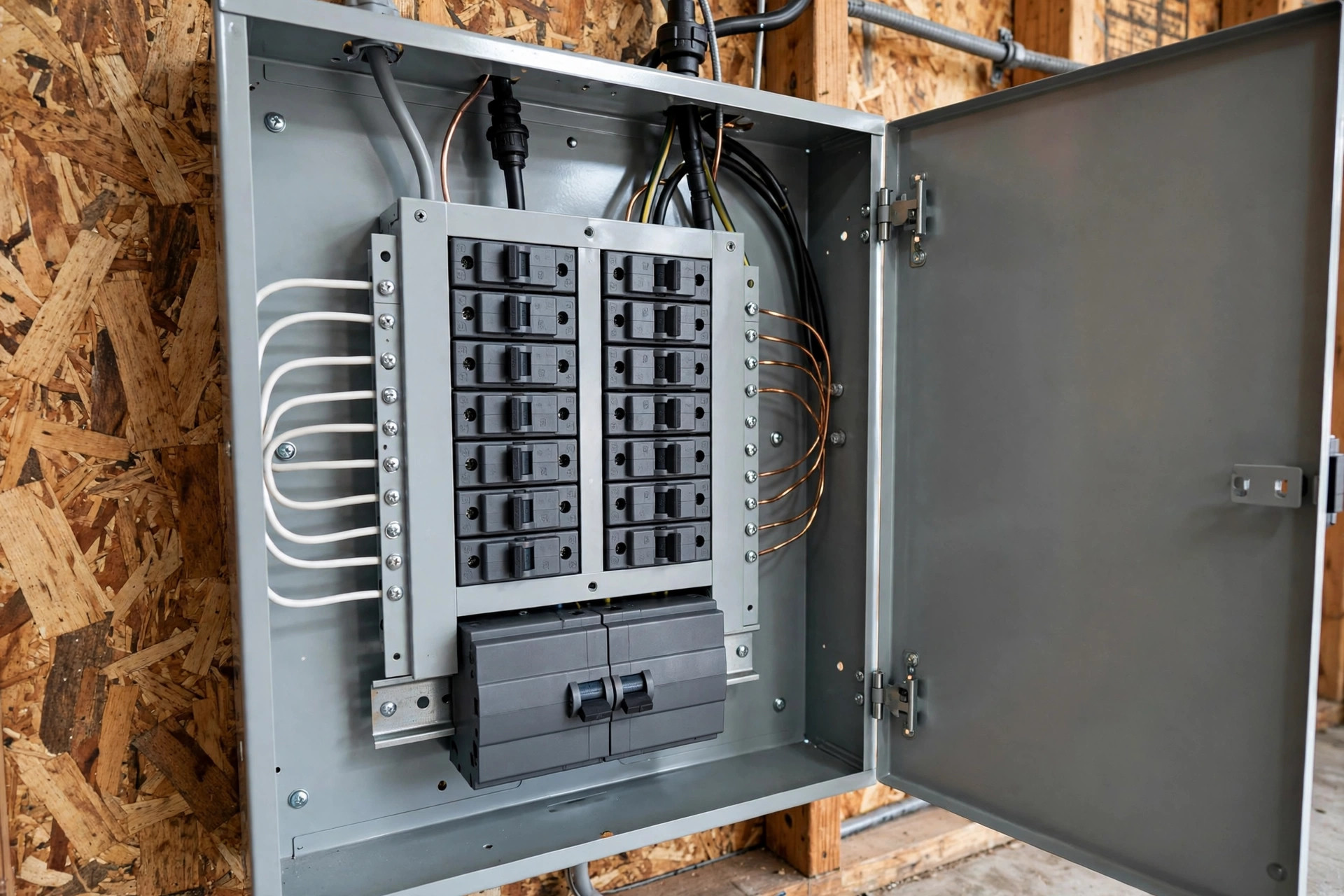
Your panel cannot take another big circuit — that is where many EV charger installs in older Leander-area homes stall. But a full panel upgrade is not the only way forward. Load management lets a charger share your home's existing electrical capacity intelligently, and for many homes it is the difference between charging this week and taking on a much bigger electrical project first.
Free referral service — we connect you with independent local installation professionals. We do not perform installations ourselves.
Why Panels Run Out of Room
An EV charger is one of the heaviest loads in a home because it pulls power continuously for hours, and the electrical code treats continuous loads conservatively. Before any charger goes in, an electrician runs a load calculation: a standardized tally of the home's big electrical demands — air conditioning, electric range, dryer, water heater, pool equipment — measured against the service size, most often 100 amps in older homes or 200 amps in newer ones.
That math is where installs get stuck. A 100-amp home in an older part of Leander, Cedar Park, or Georgetown can fail the calculation for a new 50- or 60-amp charger circuit even when the panel has empty breaker slots. Physical space in the panel and electrical capacity are two different things — and it is the capacity number, not the empty slots, that decides whether a straightforward Level 2 charger installation can proceed. When the calculation fails, the traditional answer is a bigger service. Load management is the other answer.
What Load Management Actually Does
A load management system — also called an energy management system — watches the home's total electrical draw in real time. Small current sensors clamp onto the main service conductors and report how much power the whole house is using, moment by moment. The charger is connected to that information and adjusts itself:
- When the house is quiet — overnight, with the air conditioning off and appliances resting — the charger runs at or near full speed.
- When big loads stack up — a summer evening with the AC running, dinner in the oven, and laundry going — the charger automatically slows down so the home's total draw stays within the panel's limit.
- When those loads switch off, the charger speeds back up on its own. For typical overnight charging, the car is still full by morning.
This is not a workaround that bends the rules. The National Electrical Code recognizes listed energy management systems for exactly this purpose: when a charger is controlled by one, its load may be counted at the managed level rather than the maximum the charger could draw. That is what turns a failed load calculation into a passing one, legitimately — and the install still goes through the normal permit and inspection process.
The Main Load Management Options
Installers in the Leander area typically reach for one of these, depending on the home and the charger:
- Charger-integrated dynamic load management. Several charger ecosystems pair the wall unit with a meter on the home's service. A Tesla Wall Connector can work with a compatible third-party meter to cap charging based on the home's real-time load, and brands such as Emporia and Wallbox sell chargers with their own energy monitors built for this job. This is the most common route: one charger, one meter, no panel work.
- Power sharing between two chargers. Two-EV households do not automatically need two full-size circuits. Tesla Wall Connectors, for example, can share a single circuit's capacity between two vehicles, dividing power when both are plugged in and giving one car the full circuit when it charges alone.
- A smart panel. Panels such as SPAN replace the traditional breaker box with one that measures and manages individual circuits digitally. It is the premium option — closer in scope to a panel replacement than to an accessory — and it makes the most sense when the existing panel is aging anyway.
- Circuit-sharing devices. Where a home already has a 240-volt dryer circuit near the garage, a listed switching device can share that circuit between the dryer and a plug-in charger on a NEMA 14-50 outlet, never running both at once. The key word is listed: this means purpose-built, certified equipment installed by an electrician — never a hardware-store splitter.
- Simply a smaller circuit. The low-tech version of load management is configuring the charger for a 40-amp circuit (32-amp charging) or lower instead of 60 amps. At roughly 25 miles of range per hour, a 32-amp setup still covers most daily driving with room to spare, and it passes the load calculation in many homes with no extra hardware at all.
Load Management vs. a Panel Upgrade: How to Choose
Load management usually wins when:
- Your panel is modern and safe, just close to its calculated limit.
- You have one EV today and typical overnight charging needs.
- Your heavy loads peak at predictable times, leaving long quiet windows for full-speed charging.
- The load calculation fails by a modest margin — exactly the gap a managed charger is designed to close.
A panel upgrade is still the right call when:
- The panel itself is a problem — obsolete brands such as Federal Pacific or Zinsco, visible damage, or breakers that already trip.
- The service is maxed out even under management, or you are adding a second EV plus other major electric loads.
- You are planning ahead — a workshop, a pool, an addition — and would rather build capacity once.
If you are still weighing the upgrade itself, our guide to whether you need a panel upgrade for an EV charger walks through the signs in both directions. Either way, the decision starts with the same step: a real load calculation on your actual panel, not a guess from the driveway.
What This Means for Leander-Area Homes
Leander's housing stock splits neatly in two. Newer subdivisions such as Travisso, Crystal Falls, and Bryson were generally built with 200-amp service, and most of those homes can add a charger circuit with no management and no upgrade. Older homes — in established parts of Leander and Cedar Park, around Georgetown's historic core and Sun City, and on acreage out toward Liberty Hill — are where 100- and 150-amp services are common, and where load management earns its keep.
Your utility does not change the math: whether your home is served by Oncor in Leander and Cedar Park, Georgetown Utility Systems, or Pedernales Electric Cooperative in Liberty Hill, Jonestown, and Lago Vista, capacity is about your home's service equipment, not the grid. What does not change either is the process — a charger on a managed circuit is still permitted, inspected work, and a qualified installer verifies the calculation before recommending management, a smaller circuit, or a full upgrade.
The Bottom Line
A full panel is a problem with more than one solution. Load management lets many Leander-area homeowners charge at full speed most of the time, on the panel they already own — and when an upgrade genuinely is the better answer, it should be because the numbers say so. If the numbers point that way, electrical panel upgrades in Leander, TX explains how the bigger job works and what it involves.
Panel Too Full for a Charger?
Leander EV Charger Pros is a free referral service that connects Leander-area homeowners with local EV charger installation professionals. One call gets you matched with an installer who can run the load calculation and tell you plainly whether load management, a smaller circuit, or a panel upgrade is right for your home.
Call Now to Get Connected