
Level 1 vs Level 2 Charging: What Leander Homeowners Need to Know
Every EV comes with a Level 1 charging cord — so why do most Leander homeowners end up installing Level 2? It comes down to simple arithmetic: how many miles you drive each day versus how many miles each charging level puts back while you sleep. This guide does that math honestly, including the cases where Level 1 is genuinely all you need.
Free referral service — we connect you with independent local installation professionals. We do not perform installations ourselves.
What Level 1 Charging Actually Gives You
Level 1 is the charging cord that came with your car, plugged into a standard 120-volt household outlet. There is nothing to install and nothing to permit — you are simply using an outlet that already exists in your garage.
The trade-off is speed. Level 1 adds roughly 3 to 5 miles of range per hour. Over a full night of 10 to 12 hours parked, that works out to about 30 to 50 miles back in the battery. For a plug-in hybrid with a small battery, that fills it completely. For a full EV driven any real distance, it is a slow drip.
Two practical notes if you rely on Level 1: the outlet's circuit should be in good shape and not shared with other heavy loads while the car charges, and the math only works if the car actually sits plugged in all night, every night. Miss a night, and Level 1 has no slack to catch up with.
What Level 2 Charging Changes
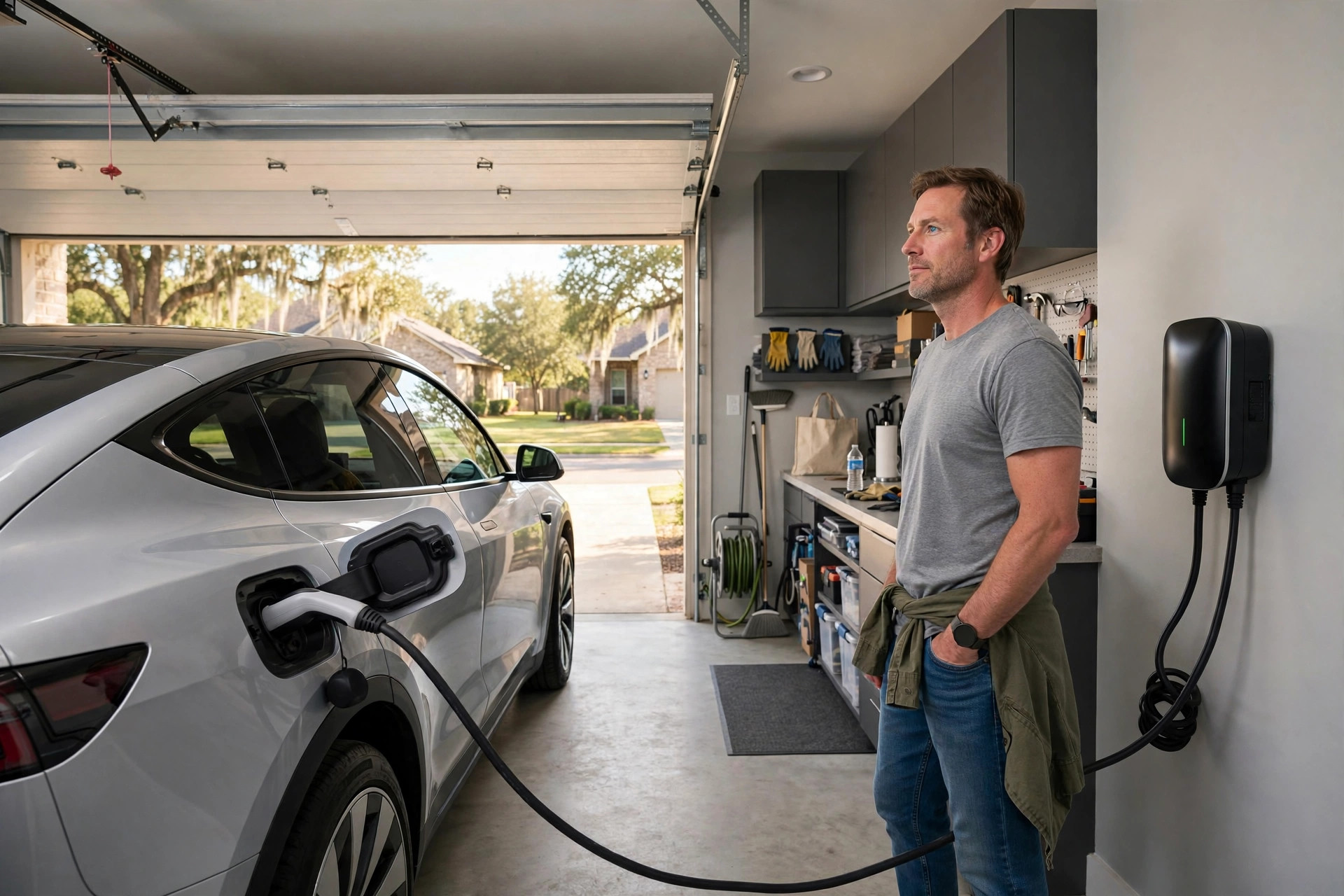
A Level 2 charger runs on a 240-volt dedicated circuit — typically 40 to 60 amps — installed by an electrician. That one change multiplies charging speed several times over: roughly 25 to 45 miles of range per hour, depending on the circuit size and how much power your particular vehicle can accept. Even a large battery that arrives home nearly empty is full by morning.
Level 2 comes in two forms. A hardwired wall unit — such as a Tesla Wall Connector — is mounted permanently and wired directly into the circuit. A plug-in charger connects to a NEMA 14-50 outlet on the same kind of circuit, which lets you unplug the charger and take it with you if you move. Both deliver the same 240-volt charging; the choice is about the equipment you own and how permanent you want the setup to be.
Because a Level 2 circuit is new 240-volt electrical work, it is permitted work in Leander — our guide on whether you need a permit to install an EV charger explains how the installer handles that process for you.
The Side-by-Side That Matters
- Power source: Level 1 — a standard 120-volt household outlet. Level 2 — a dedicated 240-volt circuit.
- Range added per hour: Level 1 — about 3 to 5 miles. Level 2 — about 25 to 45 miles.
- Overnight result (10–12 hours): Level 1 — roughly 30 to 50 miles. Level 2 — a full battery for nearly every EV on the road.
- Setup: Level 1 — none; use the cord that came with the car. Level 2 — professional installation with a permit and inspection.
- Best for: Level 1 — plug-in hybrids and light daily driving. Level 2 — daily drivers, longer commutes, and homes with more than one EV.
When Level 1 Is Honestly Enough
Not every EV household needs Level 2, and a trustworthy installer will tell you so. Level 1 can serve you well for years if:
- Your daily round trip is under roughly 30 to 40 miles, and the car is home and plugged in every night.
- You drive a plug-in hybrid — its smaller battery fills completely overnight even at Level 1 speed.
- The EV is a second car that mostly runs errands around Leander and Cedar Park.
- You have dependable charging at work to top up during the day.
If that describes your driving, there is no rush. Start with the cord in the trunk, and revisit the question when your miles change.
Signs You Have Outgrown Level 1
- The Leander commute. Plenty of local drivers cover 25 to 35 miles each way into Austin or the Cedar Park tech corridor. At 50 to 70 miles a day, Level 1 cannot reliably replace what you use — the battery slowly loses ground all week, and by Friday you are planning around it.
- You wake up short. Checking the battery before deciding where you can go, or stopping at public chargers to catch up, means home charging is no longer doing its job.
- Back-to-back days. A Saturday trip out to the lake followed by Sunday driving needs a full battery two mornings in a row. Level 1 cannot recover that fast.
- A second EV is sharing the cord. Two cars and one slow outlet leaves no slack for either of them.
- You are keeping this car — or the next one — for years. Driving patterns rarely shrink. Level 2 is the setup that stops being a daily calculation.
What Upgrading to Level 2 Involves
Upgrading is a well-worn path, and a local installer walks it the same way every time:
- Panel check and load calculation. The installer confirms your panel can carry a new 40- to 60-amp circuit. If capacity is tight, an electrical panel upgrade may be part of the plan — our guide on whether you need a panel upgrade for an EV charger explains how that call is made, and why it is needed less often than homeowners fear.
- Choose the format. Hardwired wall charger or a plug-in unit on a NEMA 14-50 outlet, matched to your vehicle and where you park.
- Installation. The electrician runs the dedicated circuit and mounts the charger or outlet. Most straightforward installations are completed in a few hours.
- Permit and inspection. Handled by the installer as part of the job, so the work is documented and to code.
The Bottom Line for Leander Homes
Level 1 is a starting point. If your daily miles are low, it can be the whole answer for a long time. But the moment your driving regularly outruns the 30 to 50 miles a night of Level 1 can return, Level 2 changes home charging from something you manage into something you never think about: plug in at night, full battery in the morning.
Not sure which side of that line your household is on? When you call Leander EV Charger Pros, we connect you with a local installation professional who can look at your panel and your driving pattern and tell you straight — including if the honest answer is that you do not need an installation at all.
Ready to make the switch? Here is how Level 2 charger installation in Leander, TX works, from the panel check to the first overnight charge.
Not Sure Which Level You Need?
Call now and we will connect you with a local EV charger installation professional serving Leander who can assess your panel, explain your options, and install the setup that fits how you actually drive.
Call Now to Get Connected