
Do You Need a Panel Upgrade for an EV Charger?
It is the question that makes many Leander homeowners pause before installing a home charger: my panel is old — will it handle an EV charger, or am I looking at an expensive panel upgrade first? The reassuring answer is that plenty of homes do not need one. Here is how to tell which group your home is in.
Published October 8, 2026 · Updated November 5, 2026
Free referral service — we connect you with independent local installation professionals. We do not perform installations ourselves.
The Short Answer
Most Leander homes with 200-amp service and open breaker space do not need a panel upgrade for a home EV charger — the charger circuit gets added to the panel. Homes with 100-amp service need a closer look, because a 40- to 60-amp charging circuit is one of the largest loads in the house, and a 100-amp panel may not have enough spare capacity once air conditioning, the water heater, and other big loads are counted. The deciding step is a load calculation under the National Electrical Code, which adds up everything the home already uses and compares it with the service size. If the numbers fit, the charger goes in with no upgrade. If they do not, the options are a smaller charging circuit, a load management device, or a full upgrade to 200 amps.
What a Panel Upgrade Actually Is
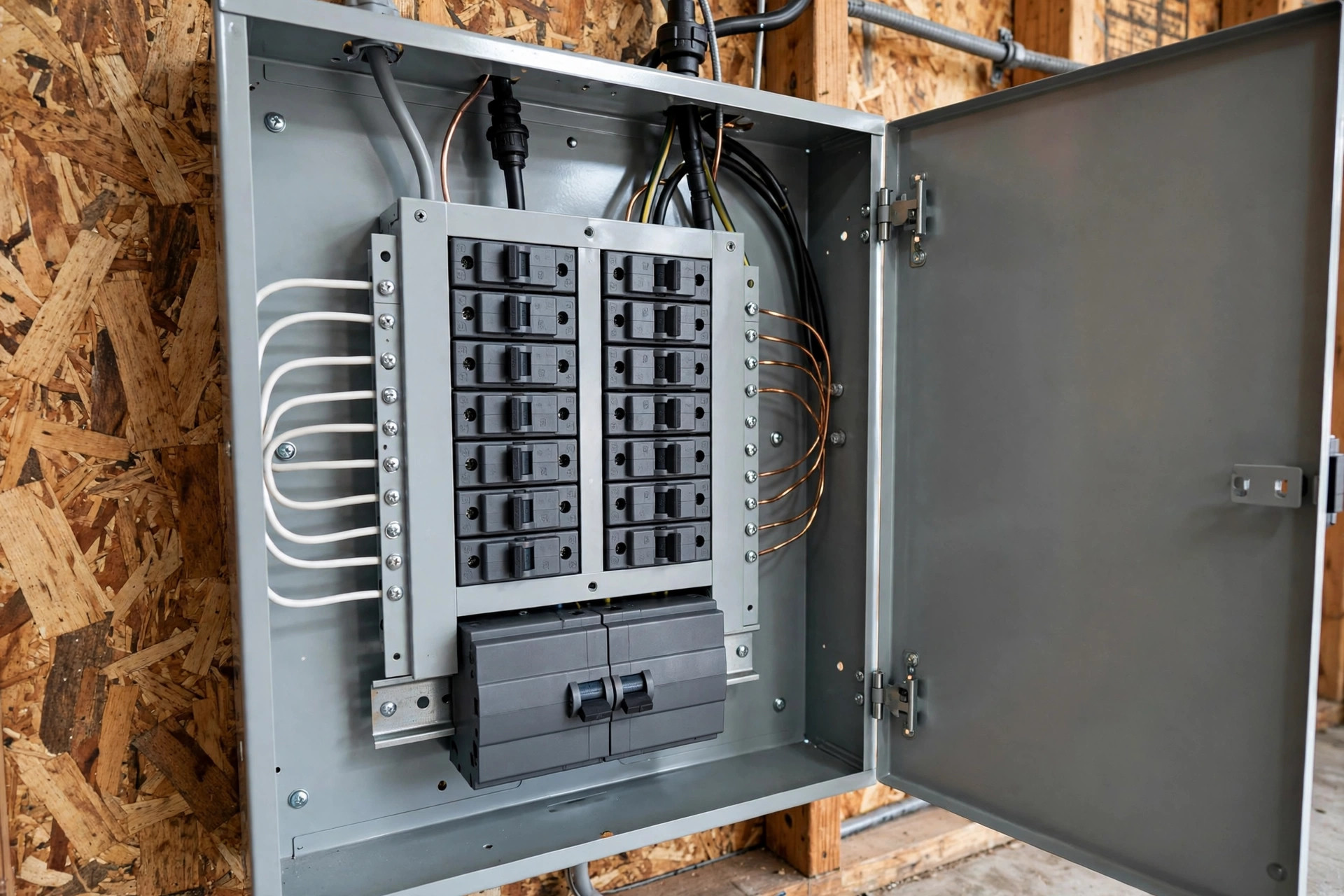
Your electrical panel is the box that distributes power to every circuit in your home, and its rating — most often 100 amps or 200 amps — is the ceiling on how much electricity your home can draw at once. A Level 2 charger typically adds a 40- to 60-amp circuit, which is one of the largest single loads in a house.
An electrical panel upgrade usually means replacing a 100-amp panel and service with 200-amp equipment, giving the home far more capacity. It is a substantial job involving the panel, the meter base, and coordination with the utility — which is why nobody should sell you one you do not need, and why the decision should come from a load calculation, not a guess.
How the Load Calculation Decides
Electricians do not guess whether a panel can carry a charger. They run a load calculation — the method in Article 220 of the National Electrical Code (NFPA 70) that adds up a home's demand and compares it with the service size. It counts the home's general loads, air conditioning, electric range and dryer, water heater, pool equipment, and the new charger circuit, then applies the code's demand factors to arrive at a single number. If that number is under the service rating, the charger fits. If it is over, something has to change.
One rule shapes the whole calculation: EV charging counts as a continuous load, because it can run at full current for three hours or more. Under NEC Article 625, the breaker and wiring for a continuous load must be sized at 125% of the charger's current — the "80% rule" in reverse. That is why a charger that draws 48 amps needs a 60-amp breaker, a 40-amp charger needs a 50-amp breaker, and a 32-amp charger needs a 40-amp breaker. The breaker is always one step larger than the charging current, and the load calculation uses the breaker's size, not the charger's.
This is also what the city inspector checks. In Leander, the permit inspection verifies the load calculation along with the wire size and breaker, so the number is not just the installer's opinion — it is part of the permitted record.
What Size Circuit Does a Charger Need?
The breaker size sets the charging speed. Tesla publishes the pairing for its Wall Connector, and the same 125% rule applies to any Level 2 charger:
| Circuit breaker | Charging current | Power at 240 volts | Miles of range per hour* |
|---|---|---|---|
| 60 amps | 48 amps | 11.5 kW | Up to 44 |
| 50 amps | 40 amps | 9.6 kW | Up to 37 |
| 40 amps | 32 amps | 7.7 kW | Up to 30 |
*Tesla's published figures for a Model 3 or Model Y Long Range; other vehicles differ, and all figures are approximate. Note the pattern: the breaker is always larger than the charging current, because of the 125% continuous-load rule above. A NEMA 14-50 outlet sits on a 50-amp breaker and charges at 40 amps, while a hardwired Wall Connector on a 60-amp breaker is the fastest home setup Tesla offers. Some Teslas cap out at 32 amps no matter the circuit, so a bigger breaker buys those cars no extra speed — the installer should match the circuit to the car, not just to the panel.
Signs You Might Need a Panel Upgrade
- Your service is 100 amps. Many older homes in Leander, Cedar Park, and Georgetown were built with 100-amp service, before EVs, and it leaves very little headroom.
- Your panel is physically full. If there are no open breaker slots for the new two-pole breaker a charger needs, something has to change.
- Breakers already trip. A panel that struggles today will not be happier with a charger pulling power for hours every night.
- Your big loads stack up. Air conditioning, an electric range, an electric dryer, a water heater, and a pool pump together consume much of a 100-amp budget in a Texas summer.
- You are planning ahead. A second EV, a hot tub, or a workshop can make upgrading once smarter than working around the limit twice.
Signs You Probably Do Not Need One
- You already have 200-amp service with open breaker space — most newer Leander homes fall into this group.
- Your large appliances are gas. A gas range, dryer, and water heater leave far more electrical capacity for charging.
- Your charging needs are modest. A smaller circuit — for example, a 40-amp circuit charging at 32 amps — still adds up to about 30 miles of range per hour on a Model 3 or Model Y Long Range (Tesla's published figure), which covers most daily driving with room to spare.
Plenty of homeowners who feared a panel upgrade turn out to need nothing more than the charger circuit itself. That is exactly why an honest load calculation matters before anyone quotes you the bigger job.
Subpanel vs a Full Panel Upgrade
A full upgrade is not the only way to make room. If the load calculation shows the service itself has capacity but the panel is physically full — no open breaker slots — an electrician may add a subpanel: a smaller second panel fed from the main one, giving the charger circuit a home without replacing the service. It works when the math fits and only space is missing.
A subpanel does not help when the service itself is the limit. On a 100-amp service where the load calculation already comes out over, adding breaker space changes nothing — the house still cannot carry the extra load. That is when the full upgrade happens: a new 200-amp panel, a new meter base, and upgraded service entrance wiring, coordinated with the utility.
Do You Need a Permit for a Panel Upgrade in Leander?
Yes. A panel or service upgrade is permitted work in Leander: the installer applies for a city electrical permit under their license, the work is inspected, and the power company coordinates the meter disconnect and reconnect around the job. In Leander and Cedar Park that is Oncor; in Georgetown it is Georgetown Utility Systems; in Liberty Hill, Jonestown, and Lago Vista it is Pedernales Electric Cooperative. The inspection checks the load calculation, the wire size, and the breaker — the same items this guide covers. Our full walkthrough of EV charger permits in Leander, TX explains the process step by step, including how it differs in Cedar Park, Georgetown, and the lake communities.
Alternatives to a Full Panel Upgrade
If your panel is tight but not hopeless, a good installer may suggest one of these instead:
- Load management devices. These monitor the home's total draw and pause or slow charging when other big loads run, keeping everything within the panel's limit. Our guide to EV charger load management explains how these systems work and which options installers use.
- A lower-amperage circuit. Setting a charger — including a Tesla Wall Connector — to a 40-amp circuit instead of 60 reduces the load while still charging overnight.
- Scheduled overnight charging. Charging while the air conditioning and appliances rest spreads the home's demand across the day.
These options do not fit every home, but when they do, they can avoid the cost of an upgrade entirely.
What It Costs If You Do Need One
If the load calculation says an upgrade is the right call, panel upgrades typically run between $1,500 and $4,000 in the Leander area, depending on scope. We break down how that fits into the total project cost in our guide to EV charger installation costs in Leander. An upgrade is also not wasted money: it raises the home's electrical capacity for everything that comes after the charger.
The Bottom Line
Do not assume you need a panel upgrade — and do not let anyone assume it for you. A local professional can run the load calculation, show you the numbers, and tell you plainly whether your panel has room, an alternative will work, or an upgrade is genuinely the right move.
Think your panel is the bottleneck? Electrical panel upgrades in Leander, TX explains how a new charger circuit gets the capacity it needs.
Frequently Asked Questions
Do I need a panel upgrade to install an EV charger in Leander?
Most homes with 200-amp service and open breaker space do not. Homes with 100-amp service usually need a load calculation first, and the calculation decides — not a guess. If the numbers fit, the charger goes in with no upgrade; if they do not, a smaller circuit, a load management device, or a full upgrade is the path.
How do I find out what size panel I have?
Check the main breaker: the number printed on it — 100, 150, or 200 — is the service size in amps, and the label inside the panel door lists it too. An electrician confirms it during the assessment, along with how many breaker slots are free.
Can I install an EV charger on a 100-amp panel?
Sometimes. If the load calculation shows enough spare capacity, the charger fits. If it is tight, a smaller charging circuit or a load management device can make it work. If the numbers still do not fit, a subpanel or a full upgrade to 200 amps is the answer.
What is a load calculation?
It is the method in Article 220 of the National Electrical Code for adding up a home's electrical demand — air conditioning, range, dryer, water heater, and the new charger — against the service size. It turns "do I need an upgrade?" from an opinion into arithmetic, and the city inspector expects to see it when a large new load is added.
Does a panel upgrade need a permit in Leander?
Yes. A panel or service upgrade requires a city electrical permit and an inspection, plus coordination with the power company — Oncor in Leander and Cedar Park — because the meter is disconnected and reconnected. The installer handles the permit and the inspection scheduling as part of the job.
How long does a panel upgrade take?
The panel swap itself is usually a one-day job, with power off for part of that day while the utility disconnects and later reconnects service. Permits and utility scheduling happen beforehand, so the calendar time from decision to done is typically longer than the hands-on work.
Sources
- National Electrical Code (NFPA 70), Article 220 (load calculations) and Article 625 (EV charging as a continuous load, 125% sizing).
- Tesla Wall Connector support page — breaker sizes, charging current, and miles of range per hour.
- EV charger permits in Leander, TX — the City of Leander permit and inspection process.
Not Sure Your Panel Can Handle a Charger?
Leander EV Charger Pros is a free referral service that connects Leander-area homeowners with local EV charger installation professionals. One call gets you matched with an installer who can assess your panel and explain your options.
Call Now to Get Connected